
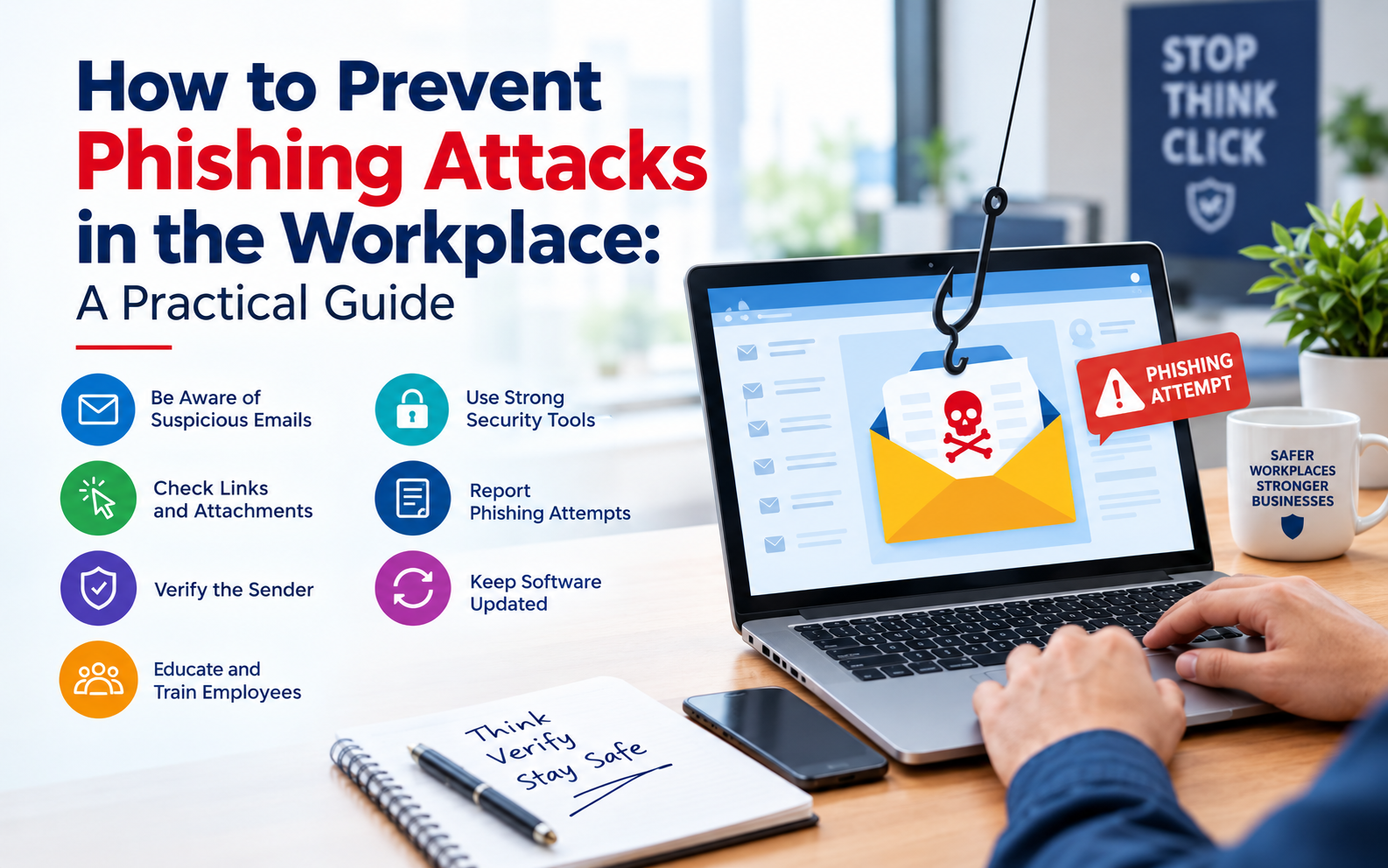
How to Prevent Phishing Attacks in the Workplace: A Practical Guide
Learn how to prevent phishing attacks in the workplace with proven strategies, employee training tips, and tools trusted by Bangalore businesses.
Introduction
A single email is often all it takes. An employee clicks a link that looks like it came from HR, and within minutes, an attacker has access to company systems. This is not a rare event, it is the most common way businesses get breached today.
Learning how to prevent phishing attacks in the workplace is no longer optional for any organization, whether you run a growing SME, a hospital, a university lab, or an AI startup handling sensitive data. Phishing remains the leading cause of data breaches worldwide, and the cost of ignoring it, financially and reputationally, keeps rising every year.
This guide breaks down practical, actionable steps for phishing prevention in the workplace, from employee training to technical safeguards, so your business in Bangalore or anywhere else can stay a step ahead of attackers.
What Is a Phishing Attack?
A phishing attack is a cyberattack where criminals impersonate a trusted source, a colleague, bank, vendor, or well-known brand, to trick people into revealing sensitive information, clicking malicious links, or downloading infected files.
Common goals of phishing attacks include:
- Stealing login credentials
- Installing ransomware or malware
- Gaining access to financial systems
- Harvesting sensitive company or customer data
Phishing doesn't always arrive as an obvious scam email. Modern attacks are polished, personalized, and often mimic real internal communications, which is exactly why workplace phishing attacks succeed so often.
Why Phishing Prevention Matters More Than Ever
Cybersecurity reports consistently show that phishing is involved in a majority of reported data breaches, and business email compromise scams have cost organizations billions of dollars globally. Attackers increasingly target employees rather than systems, because people are often the easiest point of entry.
For industries like BFSI, healthcare, and renewable energy, where regulatory compliance and sensitive data protection are critical, a single successful phishing attempt can lead to:
- Regulatory penalties and compliance violations
- Loss of customer trust
- Operational downtime
- Direct financial theft
This is why phishing attack prevention needs to be treated as a core business priority, not just an IT department task.
How to Identify Phishing Emails
Before prevention comes recognition. Teaching employees how to identify phishing emails is the first line of defense.
Common Red Flags in Phishing Emails
- Urgent or threatening language — "Your account will be suspended in 24 hours"
- Mismatched sender addresses — the display name looks legit, but the email domain doesn't match
- Suspicious links — hovering reveals a URL that doesn't match the claimed destination
- Unexpected attachments — especially .zip, .exe, or macro-enabled Office files
- Generic greetings — "Dear Customer" instead of your actual name
- Requests for sensitive data — passwords, OTPs, or payment details via email
Quick Test: The 3-Second Rule
Before clicking any link, employees should pause and ask:
- Was I expecting this email?
- Does the sender's address match exactly what I'd expect?
- Is this creating unusual urgency or pressure?
If the answer to any of these raises doubt, the email should be reported, not clicked.
Practical Steps for Phishing Prevention in the Workplace
1. Build a Structured Employee Phishing Awareness Program
Technology alone cannot stop phishing, people can, if they're trained well. Employee cybersecurity training should be ongoing, not a one-time onboarding session.
Effective phishing awareness training includes:
- Regular, short training sessions (monthly or quarterly)
- Real-world examples of recent phishing attempts
- Simulated phishing tests to measure readiness
- Clear reporting procedures for suspicious emails
Simulated phishing campaigns are particularly effective. When employees click a fake phishing email during a test, they immediately learn from the mistake in a safe environment, long before a real attacker gets that chance.
2. Strengthen Business Email Security
Since email is the primary channel for phishing, business email security deserves focused investment.
Key measures include:
- SPF, DKIM, and DMARC authentication to prevent email spoofing
- Advanced spam and malware filtering at the email gateway level
- Attachment sandboxing to detect malicious files before delivery
- Link rewriting and scanning for real-time URL threat detection
These controls work quietly in the background, catching a large percentage of phishing attempts before they ever reach an inbox.
3. Enforce Multi-Factor Authentication (MFA)
Even if a password is stolen through phishing, MFA can stop attackers from gaining access. Requiring a second verification step, an app-based code, biometric check, or hardware key, significantly reduces the impact of stolen credentials.
For BFSI and healthcare organizations handling regulated data, MFA is increasingly becoming a compliance expectation, not just a best practice.
4. Apply the Principle of Least Privilege
Limit employee access to only the systems and data needed for their role. If an account is compromised through phishing, restricted access limits how far an attacker can move within your network.
This is especially important for:
- Manufacturing companies with connected operational systems
- Universities managing research data across departments
- AI/ML companies protecting proprietary models and datasets
5. Keep Software and Systems Updated
Outdated software often contains vulnerabilities that phishing-delivered malware exploits. A consistent patch management process, covering operating systems, browsers, and plugins, closes many of these gaps before attackers can use them.
6. Establish a Clear Incident Reporting Process
Employees need a fast, simple way to report suspicious emails, ideally a single-click "Report Phishing" button integrated into their email client. Delays in reporting give attackers more time to act.
A good reporting process should:
- Take less than 10 seconds to use
- Trigger an immediate IT security review
- Include a no-blame culture, so employees aren't afraid to report mistakes
7. Monitor and Respond in Real Time
Phishing detection techniques have moved well beyond static filters. Modern security operations use:
- AI-based anomaly detection for unusual login behavior
- Real-time monitoring of email traffic patterns
- Threat intelligence feeds to block known malicious domains
Businesses without in-house security teams often rely on managed detection and response (MDR) services to maintain this level of monitoring around the clock.
Phishing Attack Prevention Strategies by Industry
Different sectors face different phishing risks, so a one-size-fits-all approach rarely works well.
- IT & SaaS companies — Attackers often target developer credentials and cloud admin accounts. Strong MFA and privileged access management are essential.
- Manufacturing companies — Phishing is frequently used as an entry point to reach operational technology (OT) systems. Network segmentation is critical.
- BFSI companies — Financial fraud through business email compromise is a top concern, requiring strict payment verification protocols.
- Healthcare organizations — Phishing that leads to ransomware can disrupt patient care. Backup and recovery planning must accompany prevention.
- Renewable energy companies — SCADA and industrial control systems connected to corporate networks need isolated security layers.
- Universities & research institutions — Large, decentralized user bases make consistent training and access control especially important.
- AI/ML startups — Intellectual property theft through phishing-based credential theft is a growing risk as proprietary models become valuable targets.
Workplace Cybersecurity Best Practices Checklist
Use this quick checklist to assess your current readiness:
- Email authentication (SPF, DKIM, DMARC) is configured
- MFA is enabled across all critical accounts
- Employees receive phishing awareness training at least quarterly
- Simulated phishing tests are run regularly
- A simple, no-blame reporting process exists
- Software and systems are patched on a defined schedule
- Access follows least-privilege principles
- Real-time threat monitoring is in place
If your organization is missing several of these, it's a strong signal that a structured cybersecurity review is overdue.
Why Gigahertz Consultants Matters for Your Phishing Prevention Strategy
Preventing phishing attacks isn't a single fix, it's an ongoing combination of technology, training, and monitoring that needs to evolve as attackers change tactics.
Gigahertz Consultants works with medium and large enterprises, SMEs, IT/SaaS companies, manufacturing firms, BFSI institutions, healthcare organizations, renewable energy companies, universities, and AI/ML startups across Bangalore and beyond to build practical, industry-specific cybersecurity defenses.
With hands-on experience in phishing protection for businesses, cloud security, and IT infrastructure management, Gigahertz Consultants helps organizations move from reactive fixes to proactive phishing email prevention strategies, including email security configuration, employee training programs, and real-time threat monitoring tailored to your industry's specific risks.
Conclusion
Phishing attacks aren't going away, they're getting more sophisticated. But with the right combination of employee phishing awareness, strong email phishing protection, MFA, and continuous monitoring, businesses can dramatically reduce their risk.
Knowing how to prevent phishing attacks in the workplace starts with treating cybersecurity as a shared responsibility across every employee, not just the IT team. The organizations that invest in this now will be the ones that avoid becoming tomorrow's breach headline.
Ready to strengthen your organization's phishing defenses? Talk to the cybersecurity experts at Gigahertz Consultants and build a workplace security strategy that actually holds up against real-world threats.
Frequently Asked Questions
1. What is the most common type of phishing attack in the workplace?
Email-based phishing is the most common form, often impersonating executives, vendors, or IT departments to trick employees into clicking malicious links or sharing credentials.
2. How often should employees receive phishing awareness training?
Quarterly training sessions, combined with periodic simulated phishing tests, are considered a strong baseline for most organizations.
3. Can technology alone prevent phishing attacks?
No. Email filters and authentication protocols block many threats, but trained, alert employees remain essential since some phishing emails will always slip through technical defenses.
4. What should an employee do if they suspect a phishing email?
They should avoid clicking any links or attachments, report the email through the organization's designated reporting channel, and wait for IT confirmation before taking further action.
5. Does multi-factor authentication really help against phishing?
Yes. MFA prevents attackers from accessing accounts even if they successfully steal a password through phishing, adding a critical extra layer of protection.
6. Are small businesses also targets of phishing attacks?
Yes. SMEs are frequently targeted because they often have fewer security resources than large enterprises, making them attractive, lower-effort targets for attackers.
Category: SCADA